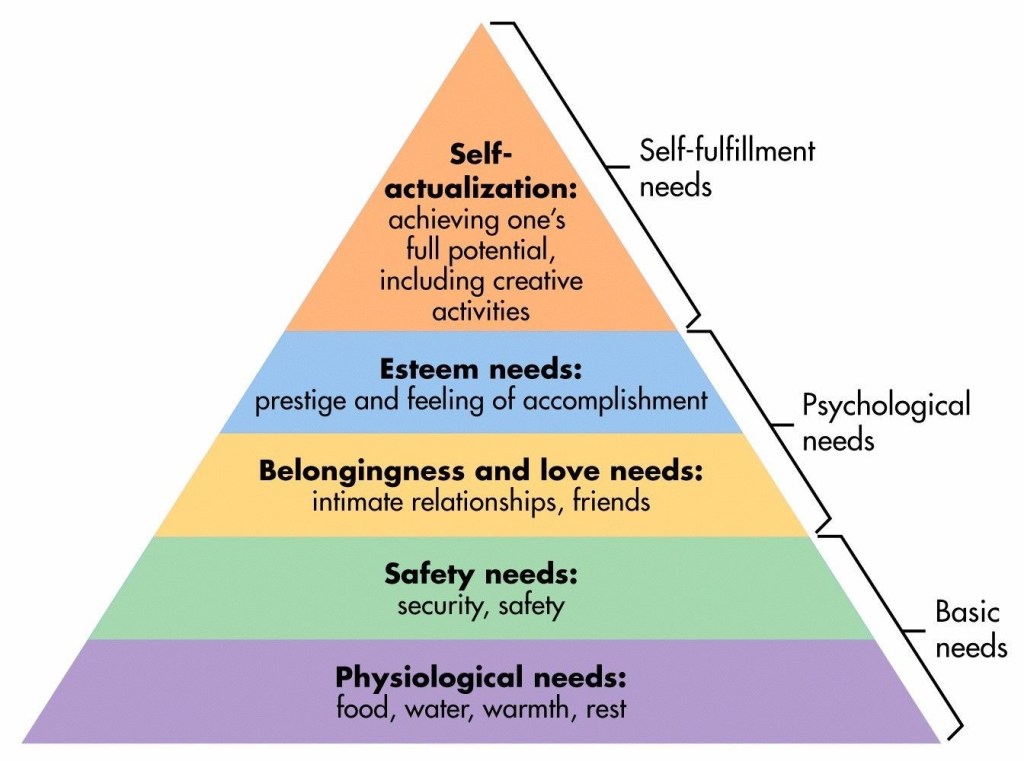
Maslow’s Hierarchy of Employee Engagement

How do you foster employee engagement? How do you know the best way to motivate an employee to be more productive? What about team building; what’s getting in the way of those connections? The answers are all in the pyramid above; Maslow’s Hierarchy of Needs.

Employees, teams, and organizations are all operating at a different level of this hierarchy and at different levels of employee engagement. Some team members might have all their basic needs met and next want to meet their need for belonging. By contrast, others might be unable to pay their bills with the wage they make. Because of this we must meet people at the level they are at on the hierarchy. If we do not then efforts to motivate and engage will not be effective. I often use the example here that if someone is unable to pay their bills and they feel unsafe at work a team building exercise is going to fall flat. Why? Because they are not operating at that level.  
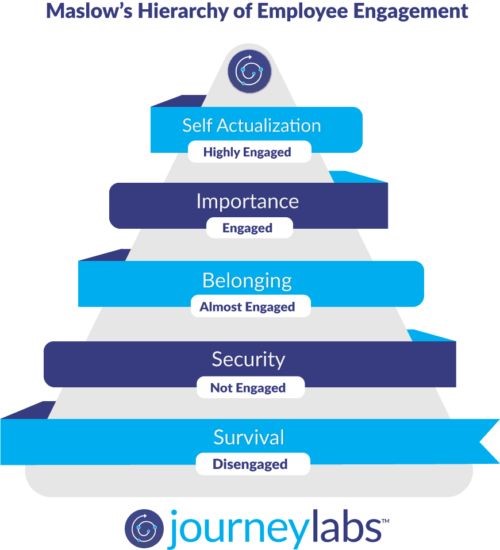
Getting Started: Basic Needs

Where to start? Let’s start at the bottom; we must begin by addressing the most basic needs of an employee. Only then will we have any hope of creating an engaged team. Employees who are not having their basic needs met will be the ones most likely to be actively disengaged. This means that they will actively work against the purpose and goals of the business. These are the employees who are giving food away for free, sneaking money from the register, and calling out “sick” on the busiest night of the week. In the white collar world, these are the employees who do the bare minimum to not get fired. They show up late and leave early. They waste time at their desks looking at social media. These employees will jump at the chance to talk trash about the company.
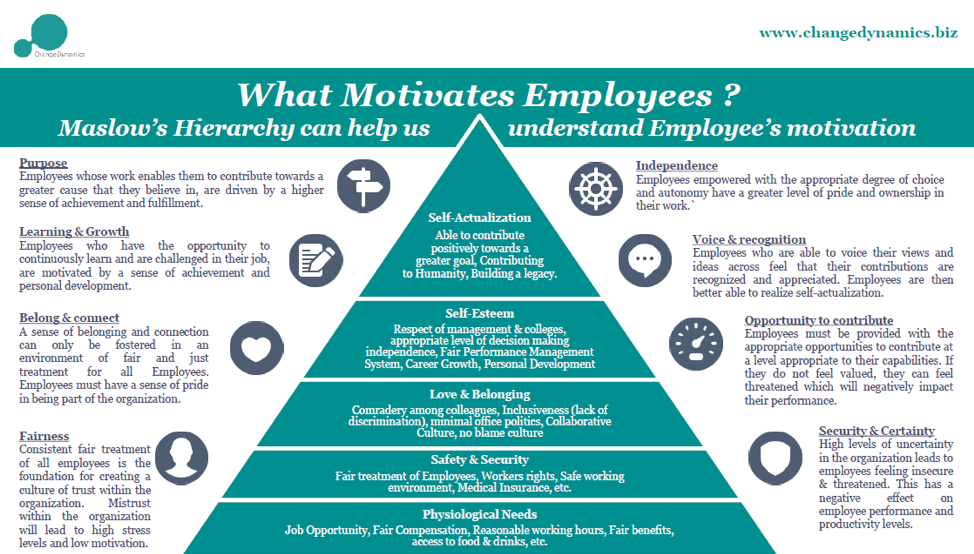
What is needed to no longer be actively disengaged?

  • Food and water (aka money to eat and feed your family)
  • Shelter (aka the money to pay your rent and live in a safe and secure location)
  • Rest (aka time to recover and get enough sleep)
  • Equitable treatment of workers (aka fair application of rules)
  • Job security (aka not in fear of job loss)
  • Safety
  • Medical Coverage (aka can go to the doctor when needed)

These are folks who will feel neutral about the organization, their job, and their coworkers. They aren’t likely to steal time or miss deadlines. That said, you can be sure that they won’t be going above and beyond.

Moving From Neutrality to Engagement

To move from neutrality to actual engagement more is needed:

  • Comradery (aka connection to your coworkers)
  • Inclusivity (aka you can bring your whole self to work)
  • Lack of office politics (aka no favoritism)
  • Culture of collaboration and respect (aka fair chance to contribute and have your ideas respected)
  • Reasonable independence (aka not micromanaged)
  • Fair and effective performance management (aka you know where you stand in terms of your performance)
  • Opportunity to grow and develop

These are the employees who will go above and beyond. They will feel energized by their work and have a clear line if site to the top goals of the organization. They will also see how their contribution helps make those goals a reality. These employees will feel a sense of balance in their lives between work and home, see a previously posted article on this here: https://worklifepathways.wordpress.com/2021/02/26/the-workplace-of-the-future/.

Outlined below is the “anatomy of an engaged employee”:
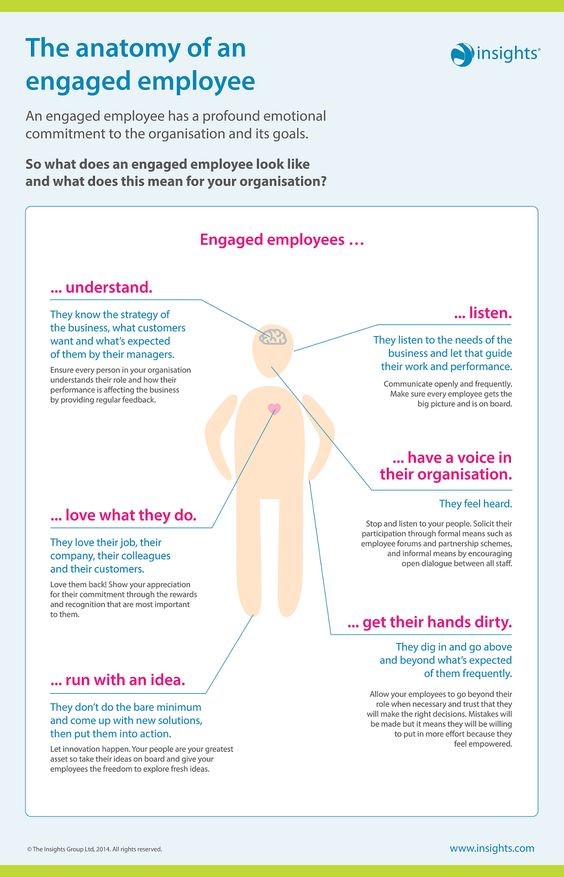
The Next Level – High Engagement

This is the point where an organization’s mission, purpose, vision, and values become extra important. If the organization exists for a higher purpose and is on a mission to fulfill that purpose and make their vision a reality by living their core values, it has long-term potential. The employees who connect with all of the above are the ones who become highly engaged. They are the ones who will work nonstop to make sure that the business is successful. This is where true employee engagement happens.

Conclusion

Engaged employees drive high-performing organizations. That’s why understanding employee engagement is critical to long-term business success.

  • Meet the basic needs of your employees
    • Pay them enough to cover their bills and give them down time
    • Foster a stable environment of consistency and fairness
    • Make sure they feel safe and can go to the doctor as needed
  • Meet the psychological needs of your employees
    • Create the space/time for comradery and connection
    • Create a culture of inclusivity, collaboration and respect
    • Give employees clear goals and expectations
    • Empower them to get the job done
    • Ensure employees always know where they stand in terms of performance
    • Give employees the ongoing opportunity to grow and develop
  • To unlock the highest level of engagement within your organization:
    • Have a virtuous purpose/mission for existing in the first place
    • Have a strong set of core values that you use to guide your action towards that purpose/mission
    • Hire and engage employees that identify with that purpose/mission and core values

If you liked this content, please subscribe below. Thank you for reading!

The Higher Purpose of Capitalism Pt.1

Thank you for joining us for week 1 of the HR Book Club Blog. This month we’re reading “Conscious Capitalism” by John Mackey and Raj Sisodia.

Countries that have embraced free enterprise capitalism have prospered tenfold over those that have not, and the face of the world has improved substantially because of it. The authors give some quality of life improvement facts in Chapter 1 that are staggering:

  • In 200 years capitalism has taken the levels of extreme poverty down from 85% to 16%.
    • “Adjusting for affordability and quality improvements, the standard of living of ordinary Americans has increased 10,000% since 1800!”
    • Major strides in sanitation, medicine, and agricultural productivity have led to massive growth in worldwide human population, and life expectancy has more than doubled.
    • Malnourishment and hunger has been cut in half worldwide.
    • Literacy levels have spiked with 84% of adults now able to read in developed countries.
    • Minority groups have more rights within democratic governments, and overall life satisfaction levels correlate with this economic prosperity.

The authors feel that entrepreneurs in particular are the real heroes of the modern day, saying that they are “every bit as bold and daring as the heroes who fought dragons or overcame evil.” After all it is the entrepreneur who envisions the world in ways it could and should be, and who creates wealth through creativity and passion.

Capitalism has earned a bad wrap as greedy and exploitative, but at it’s core capitalism and for-profit business has the ability to create prosperity at a level previously unforeseen. The authors define conscious business as “business galvanized by higher purposes that serve and align the interests of all their major stakeholders; business with conscious leaders who exist in service to that company’s purpose, the people it touches, and the planet; and businesses with resilient, caring cultures that make working there a source of great joy and fulfillment.” They believe that taken together these things can create better communities and a better world through purpose, love, creativity, compassion, freedom, and prosperity.

The trouble is most businesses can be considered low-conscious; failing to recognize their impact on the environment and animal life as well as on the physical and mental health of team members and customers. Employee engagement levels haven’t improved in the last 20 years hovering around 30% and executives are paid 325+:1 the amount that low level employees make. The idea that business, like people, is purely self-interested and focused on profit maximization has allowed these practices to run unchecked under the guise of inevitability. All of this is made worse through government coercion that seeks to consolidate power and market-share for the benefit of officials.

The real purpose of business is a virtuous one: “to improve lives and to create value for stakeholders.” While money is one form of value, it is not the only one that should be considered. This quote really spoke to me:

“This is what we know to be true: business is good because it creates value, it is ethical because it is based on voluntary exchange, it is noble because it can elevate our existence, and it is heroic because it lifts people out of poverty and creates prosperity. Free-enterprise capitalism is one of the most powerful ideas we humans ever had. But we can aspire to even more. Let us not be afraid to climb higher”

It’s time that we fully embrace business as a powerful force for good; one that we must use responsibly. Once this power and responsibility is realized we will see a massive cultural shift in how people view their part in business and free-enterprise capitalism.

What are your thoughts?

  • Is capitalism virtuous in nature?
  • Why has business developed this greedy and exploitative image?
  • How can we leverage business for good across all stakeholders?

#capitalism #virtue #conscious

The Ripple Effect

Both great jobs and poor jobs lead to a ripple effect around you. At a great job you will feel fulfilled, energized, and committed to the higher purpose of an organization. This not only creates a direct ripple effect on those you serve but also impacts every interaction you have throughout a given day.

Someone who feels a sense of fulfillment with their work is more likely too be generous with their time and energy; they are more ready and able to help a neighbor or friend and to be present for their spouse or children when they get home from work and recharge on the weekends.

The same ripple effect happens when you are working a poor job at an unhealthy company. You will feel drained and unfulfilled by your work coupled with a lack of motivation that comes with disconnection from the purpose of the organization. This ripples out not only into the quality of your work and how well you serve the customer but back out into society as a whole.

You will be less likely to have the time or energy to help a neighbor or friend, be present for your family, and even care for yourself. The workplace has a powerful ripple effect.

As leaders and business owners we need to be mindful of this impact with every business decision and interaction.

The Workplace of the Future

When I picture the workplace of the future the word that comes to mind is “balanced.”

I see:

– 40 hour work weeks (or less!) typically 8am to 4pm

– 30 minute lunches, on site, with colleagues in a comfortable space

– Flextime and up to 40% of the work week conducted remotely

– Commutes under 30 minutes each way

– Always “home by dinner”

– Holidays and weekends off

– 5 weeks paid vacation time, ideally the whole company would take vacation around the same time so work is truly stopped

– Health and family always come first; be 100% when you’re in the office

– When at work; work intensely & leave work at the door when you leave

– Free on-site childcare from 6mo to 6 years

– Inclusive and positive cultures

– Pay equality and diversity in upper level leadership

– You are trusted and supported to get the job done

– Comprehensive medical coverage

– Work-spaces simple in design but smart, uncluttered, and comfortable

– 12 to 24 weeks paid maternity, paternity, and adoption leave depending on criteria

– Adjustable desks and meeting space that allow for both sitting and standing

– Retirement matching up to 10%

– Compensate at a living/ fair rate across the company

Thoughts?